A 3D Approach to Integrating Industrial Structures with Process Equipment
June 2009
By: Troy Bernhardt & Ed Nemetz
www.utieng.com
Unified theory, Inc. (UTI) engineers are using a 3D modeling approach to improve the design speed and quality of industrial facilities. This allows engineers to address the complexity and short design schedules for projects while integrating mechanical and structural systems.
Among the many challenges for designers of industrial facilities is the coordination of structural systems with the manufacturing process equipment due to changes that occur during design development. Industrial structures are a clear example of building types where the structural system conforms directly to the arrangement of process equipment. Though the owner’s investment in the manufacturing process represents a substantial part of the capital cost, the structural systems must be integral to the equipment needs to achieve overall economy. Due to accelerated design and construction schedules, engineers often begin structural design early in the project when the manufacturing process is still conceptual and before the final equipment selection. This can lead to an inefficient design effort and costly changes during construction.
Often, the structural engineer has to make critical decisions about materials, loading, and framing while the manufacturing process is yet undefined. Industrial projects do not usually allow the flexibility for designers to assume repetitive column bays and story heights such as in commercial or institutional buildings. The design team and owners start with a general idea of how the structure relates to the overall process, but the structural engineer often has to proceed with the design of specific structural members long before adequate shop drawings and equipment mounting details are available to complete the design.
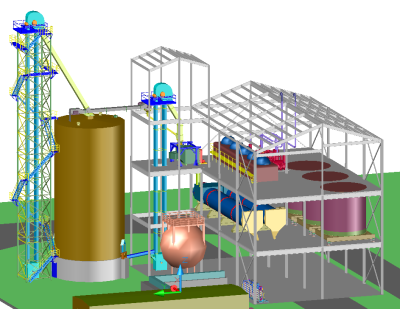
Industrial Process Facility 3D Model
While engineers need to consider how equipment and structural members relate to each other in three dimensions, construction documents are typically drawn as two-dimensional floor plans and elevation views. This creates a challenge for the designers to provide enough information for decision makers to visualize the design at all stages of development.
A typical project might have a series of blending vessels and storage tanks connected by material handling systems. The mechanical engineers would start by laying out the preliminary equipment sizes based on the specified system capacities along with descriptions of access needs and requirements for protection from the elements. At this point the mechanical engineers would pass the general arrangements and preliminary cut sheets to the structural engineers who use the rough layout to start designing buildings and structures. However, the size of the vessels could still change, the exact mounting locations might be unknown until later in the project or the location and heights of the vessels could change as designers develop the process details. The structural engineer might provide approximate sizes of beams and columns but then need to change them repeatedly as changes occur and more details are available.
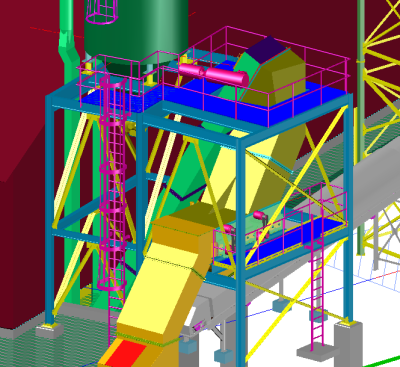
3D Model of Equipment Platform
In one case, the engineers might lay out the process and design the supporting framework only to find that the sizes of a series of floor openings must change in order to accommodate a rerouted material handling system. This seemingly minor change could require the redesign of several beams at each opening and the re-analysis of the major framing members within each affected bay. In another case, the floor height might have to change to add headroom for larger conveyors and ventilation equipment which would then affect column and bracing designs.
The structural engineer is faced with compromising between two approaches:
Begin with a preliminary design, and modify repeatedly throughout the refinement of the process arrangement. This is inefficient and can result in uneconomical designs or costly field changes.
Wait for relatively complete process equipment information before starting the design of structural members that provide support, required access, and shelter. Although this approach appears to improve design efficiency, it reduces the communication needed to coordinate the structural system with other disciplines and to provide essential information to the owner and contractors. In addition, it is not possible to wait when owners decide to start construction before the process is finalized.
To fully integrate the design of structural systems with the process equipment, engineers need to share conceptual information early in the project timeline when the process layout is still incomplete. Throughout the entire project, collaboration and flexibility are critical for accuracy and quality. It is necessary to continue sharing information and refining the structural design as the process layout evolves. In many cases, structural details cannot be finalized until after final certified equipment drawings are available late in the project or during construction.
Structural Design Development for Industrial Facilities
Structures for industrial facilities support very heavy loads with complex framing arrangements designed to fit around the process. The framing needs to be economical but it also has to accommodate equipment footprints, material handling systems, floor openings, and access for personnel. Typically, the mechanical engineers begin with a conceptual process flow diagram and general arrangement drawings for review. At this point, the structural engineers lay out preliminary framing of beams, columns, and foundations to give a sense of how the structural system interacts with the process layout. The designers assemble cost estimates and continue design development by considering the numerous building, structural, mechanical, electrical, and site requirements. With active participation of the owner and other technical disciplines, the team develops a more detailed design as the process equipment is specified and vendors submit shop drawings. At each step, the structural engineers perform calculations to determine structural member sizes and communicate the results through two-dimensional construction drawings that need to be updated and reissued at every phase of the design.
3D Modeling: Unified Theory’s Approach to Industrial Structures Design
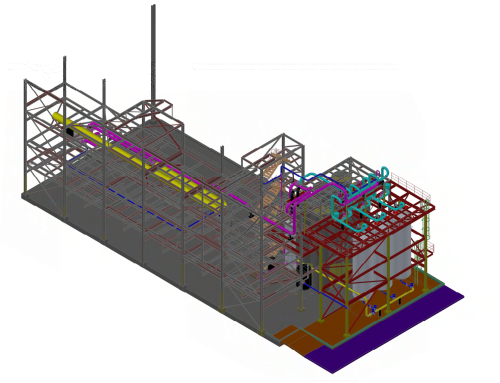
Structural engineers at Unified Theory, Inc. (UTI) use 3-Dimensional (3D) modeling extensively in the design of new or retrofitted industrial facilities. UTI had been using up-to-date structural engineering procedures and software for conventional building design but found that the geometries of the industrial buildings sometimes became difficult to manage. These multilevel structures support machinery at each level that is interconnected vertically, horizontally and diagonally by material handling systems, ducts, chutes, and piping that cross the structural grid at all angles. UTI engineers developed an approach to modeling the process equipment in 3D to show the required relationships between equipment and to look for interferences between mechanical components. By combining the structural and process layouts into a single 3D model, UTI creates a powerful design and communication tool that benefits the engineers and the owners.
As a communication tool, the 3D model facilitates coordination between the structural engineers, architects, and process engineers. By sharing the same model, each discipline has an active role in coordinating their designs with the other team members. In addition, UTI uses the 3D model to walk the owners through the overall design of the process and facilities at each phase and to develop visual responses to questions or requests.
3D Modeling Tools
UTI uses several different software programs for 3D modeling and structural design. Since each program on the market offers unique capabilities, UTI matches the appropriate tools to the project needs. The best solution usually means that the structural engineers need to apply multiple programs for structural analysis and design to accomplish different tasks. UTI designers also use several CAD programs to accomplish the transfer of 3D information to 2D documents.
After evaluating different software options, UTI chose RAM Structural System from Bentley to use for 3D modeling of industrial structures. It has the ability to include the entire framing system in the model and to design individual members and connections for gravity and lateral loads. RAM Structural System also incorporates the analysis of seismic and wind loads, floor vibration, and it checks vertical and horizontal deflections from the model.
For coordination between disciplines, UTI uses AutoCAD from Autodesk, Inc. to assemble all of the process and structural information together into a single general arrangement (GA) model. Since the main intent of the RAM software is to model the structural geometry and properties from an analysis and design perspective, an additional step is required to convert the information in the model into AutoCAD objects.
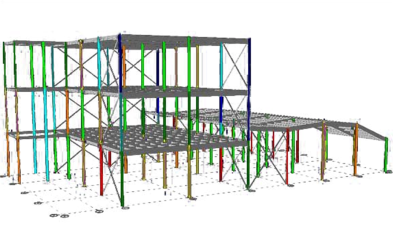
3D RAM Structural Model
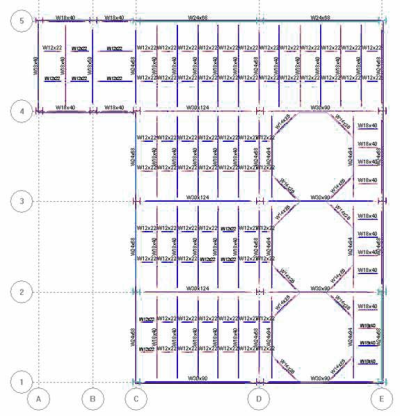
2D AutoCAD Plan Drawing
Structural software offers great benefits for industrial buildings. The model can easily accommodate other point loads or hanging loads such as process piping, electrical equipment, and cranes throughout the structure. Another benefit to using structural software is the ability to get the steel takeoff at any time during the project. This can help with the task of creating cost estimates during the preliminary phase, ordering steel for the project, and obtaining estimates of proposed framing changes during later project phases.
Because of the dynamic nature of many projects, the design often changes so what appears to be the best design solution at the start will become much different by the end of the project. Even if the engineers start with a preconceived conceptual design, the owner or members of the team may consider alternative concepts. It is quick and easy to explore different options in the 3D model and to produce a visualization to help in the selection of the best concept. Since the software also provides structural design results, the engineers can obtain a quick understanding of the structural requirements for each option and the effects on process equipment integration.
Since industrial buildings usually fit closely to the process layout, additional challenges arise during the engineering phase. Process equipment presents complicated loading footprints which result in each beam receiving unique applied loadings. Structural software minimizes the computations necessary to distribute loading to other structural members and to verify assumptions about uniform loading applied to floor areas. When changes occur after the analysis is complete, the engineer can update the 3D model with the revised structural members and observe the effect on the entire frame. Process changes that occur after analysis can be adopted easily with the structural software with reduced chances for error in determining tributary loads and reactions.
When all of the engineering disciplines assemble their 3D models together they can see situations where there are interferences between objects. Typically, the mechanical engineers design the process equipment and place it into the 3D model as a general arrangement. After the process equipment is placed in the GA, the structural model is merged into the GA to create the 3D model for coordination.
While engineers use software to perform the calculations, a few things still must be checked manually. One of the key items is to verify process equipment connections to the structural steel. Using the approved shop drawings from the equipment, engineers can easily determine if the bolted connections to the structural steel will fit correctly and make installation easier. It is also important to check for conflicts with smaller systems such as piping, conduits, and control panels that might be excluded from the model.
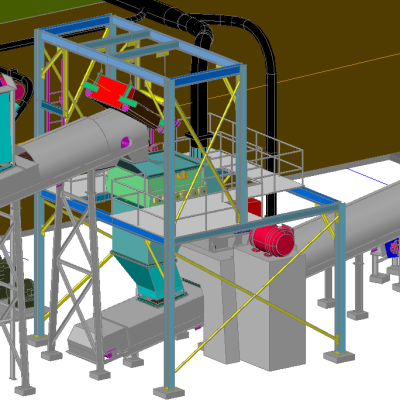
Structural Platform for Material Handling Equipment
A 3D model in AutoCAD can present several issues. Each piece of process equipment can be modeled with inaccurate shop drawings. The result will be an inaccurate 3D representation of the equipment, which may result in some interference or conflict. This will lead to items in the field that require attention. Another possible issue is the method of installation. For example, a bucket elevator requires a certain amount of clearance in the floor openings; during installation it requires additional space to get everything to fit. This can easily be overseen while viewing the 3D model before construction begins
Other programs are available to help coordinate disciplines but UTI has had the most success with AutoCAD and RAM Structural System. UTI uses the RAM software along with AutoCAD to produce 3D models that provide significant benefits for clients. After every project is completed in 3D, UTI conducts internal reviews for continuous improvement to develop a better understanding of modeling for future projects. As new and updated software becomes available, UTI will continue to upgrade its software technology and improve engineering procedures to serve the clients’ needs.
Benefits
The application of 3D modeling to industrial projects has helped UTI improve design quality and efficiency. 3D modeling is a tool that improves the overall design with better integration of process equipment and the structural system. The design tasks proceed quicker than traditional methods, which aids the engineers in producing functional 3D design information early in the project. The resulting 3D model is an excellent communication tool between the designers and the owners and for coordination between disciplines.